
The U.S. Senate Committee on Commerce, Science, & Transportation (Commerce Committee) recently held a nomination hearing to fill two vacancies on the Surface Transportation Board (STB), the economic regulator of railroads. The nomination hearing of Patrick Fuchs and Michelle Schultz provided Senators with a venue to vent concerns related to the U.S. rail system. In particular, Senator Wicker (R-MS) voiced concern over freight train interference of Amtrak passenger trains.
Congress created Amtrak in 1970 to relieve freight railroads of their responsibility to provide intercity passenger rail service. In exchange, Congress required the freight railroads to permit Amtrak to have access to their rail lines.[1] In 1973, Congress codified the requirement to give Amtrak trains preference over freight trains. Under federal law, Amtrak has preference over freight transportation in using a rail line, junction, or crossing.[2]
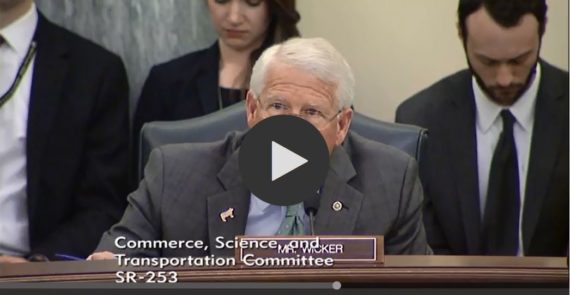
In the Commerce Committee hearing, Senator Wicker prefaced his questions to the nominees with a monologue about Amtrak’s right to proceed ahead of freight traffic when Amtrak and a freight train converge at the same time. Senator Wicker explained that under the current legislative framework, Amtrak has preference over freight transportation in using a rail line. But, he expressed concern that the law is not stringently followed - in reality freight railroads have consistently denied such preference to Amtrak, in fact only 47% of long distance [passenger] trains were on-time at stations in FY 2017 and this is largely attributable to freight’s refusing to provide preference to passenger rail.
See Senator Wicker’s statement here: (skip to 1:14:20 – 1:15:16)
At this time, preference can only be enforced through U.S. Department of Justice action.[3] The STB’s authority to hear on-time performance complaints relating to preference is in question after a decision at the 8th Circuit and a series of decisions in the D.C. Circuit.[4] Amtrak has asked Congress to provide it with a private right of action to enforce its statutory preference rights.[5]
[1] Rail Passenger Service Act of 1970, P.L. 91-518, 84 Stat. 1334 - 35 (Oct. 30, 1970).
[2] Amtrak Improvement Act of 1973, P.L. 93-146, 87 Stat. 552 (Nov. 3, 1973).
[3] 49 U.S.C. § 24103.
[4] See Union Pac. R.R. Co. v. Surface Transp. Bd., 863 F.3d 816 (8th Cir. Feb. 8, 2017); Assoc. of American R.R. v. Dept. of Transp., et al., No. 11-1499 (JEB) (D.D.C. Mar. 23, 2017).
[5] Rail Safety and Infrastructure-Stakeholder Perspectives: Hearing Before Comm. of Approp. Subcomm. on Transp., Housing, and Urban Development, and Related Agencies, 115 Cong. (2018)(testimony of Stephen Gardner, Executive VP & CCO, Amtrak). Available here.

Nossaman’s 30-plus infrastructure attorneys offer clients, colleagues, strategic partners and industry media a wealth of practical experience, insider insight and thoughtful analysis here on Infra Insight. We blog about what we know best, from industry-leading procurements to local and national policy developments that affect the market and our clients.
Stay Connected
 RSS Feed
Categories
- Airports
- Alternative Project Delivery
- Bridges
- California Environmental Quality Act
- Cybersecurity
- Design-Build
- Financing
- High-Speed Rail
- Job Opening
- Legislation
- News
- P3s
- Policy
- Ports
- Rail and Transit
- Social Infrastructure
- Tollroads/ Turnpikes/ Managed Lanes
- Transportation Infrastructure
- Tunnels
- Water
